Subway slayings, p.1
Subway Slayings, page 1
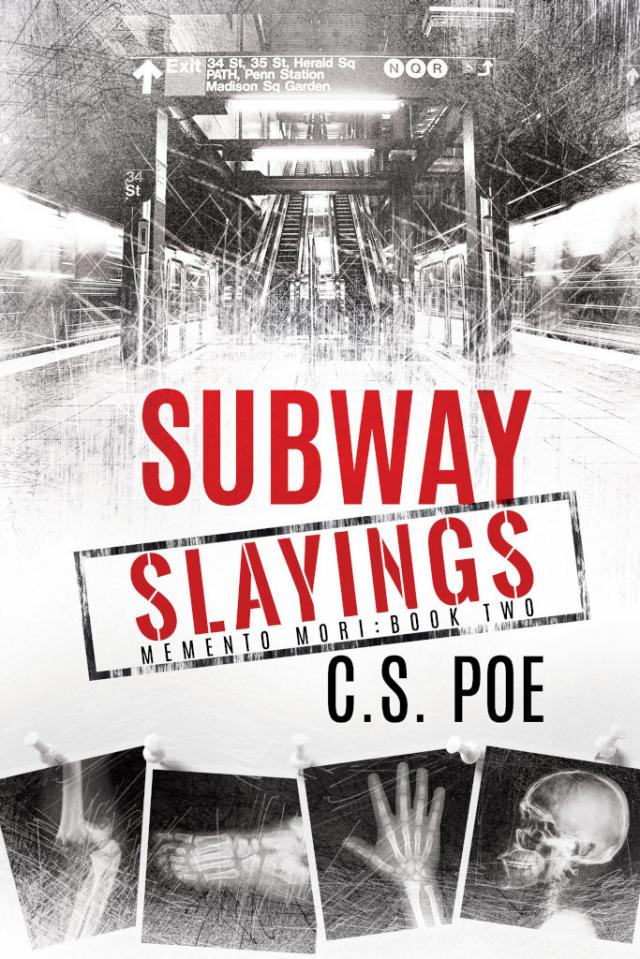


Subway Slayings
(Memento Mori: Book Two)
By
C.S. Poe
Subway Slayings
By: C.S. Poe
Detective Everett Larkin of New York City’s Cold Case Squad has been on medical leave since catching the serial killer responsible for what the media has dubbed the “Death Mask Murders.” But Larkin hasn’t forgotten that another memento—another death—is waiting to be found.
Summer brings the grisly discovery of human remains in the subway system, but the clues point to one of Larkin’s already-open cases, so he resumes active duty. And when a postmortem photograph, akin to those taken during the Victorian Era, is located at the scene, Larkin requests aid from the most qualified man he knows: Detective Ira Doyle of the Forensic Artists Unit.
An unsolved case that suffered from tunnel vision, as well as the deconstruction of death portraits, leads Larkin and Doyle down a rabbit hole more complex than the tunnels beneath Manhattan. And if this investigation isn’t enough, both are struggling with how to address the growing intimacy between them. Because sometimes, love is more grave than murder.
This is a work of fiction. Names, characters, places, and incidents either are the product of the author’s imagination or are used fictitiously, and any resemblance to actual persons, living or dead, business establishments, events, or locales is entirely coincidental.
Subway Slayings
Copyright © 2022 by C.S. Poe
EPUB Edition
All rights reserved. No part of this book may be reproduced in any form, stored in any retrieval system, or transmitted in any form by any means—electronic, mechanical, photocopy, recording, or otherwise—without prior written permission of the publisher, except as provided by United States of America copyright law. For permission requests and all other inquiries, contact: contact@cspoe.com
Published by Emporium Press
https://www.cspoe.com
contact@cspoe.com
Cover Art by Reese Dante
Cover content is for illustrative purposes only and any person depicted on the cover is a model.
Edited by Tricia Kristufek
Copyedited by Andrea Zimmerman
Proofread by Lyrical Lines
Published 2022.
Printed in the United States of America
Trade Paperback ISBN: 978-1-952133-41-1
Digital eBook ISBN: 978-1-952133-40-4
For Kale.
Thank you for elevating this series to something more.
AUTHOR’S NOTE
Detective Neil Millett hails from the Snow & Winter series. The Memento Mori series can be read without any prior knowledge, but for his character origin, begin with Book 1, The Mystery of Nevermore.
Table of Contents
Cover
Title Page
Subway Slayings
Copyright Page
Dedication
Author’s Note
Memento Mori
CHAPTER ONE
CHAPTER TWO
CHAPTER THREE
CHAPTER FOUR
CHAPTER FIVE
CHAPTER SIX
CHAPTER SEVEN
CHAPTER EIGHT
CHAPTER NINE
CHAPTER TEN
CHAPTER ELEVEN
CHAPTER TWELVE
CHAPTER THIRTEEN
CHAPTER FOURTEEN
CHAPTER FIFTEEN
CHAPTER SIXTEEN
CHAPTER SEVENTEEN
CHAPTER EIGHTEEN
CHAPTER NINETEEN
CHAPTER TWENTY
Up next…
About C.S. Poe
Also by C.S. Poe
MEMENTO MORI
Remember that you must die.
CHAPTER ONE
It was Tuesday, May 19, 4:57 p.m., and there was a body in a blue IKEA tote bag.
A uniformed officer lifted the crime scene tape cordoning off the stairs to the Fifty-Seventh Street platform, and Detective Everett Larkin ducked underneath. The subway system was over a century old, carved into the ancient bedrock that Manhattan sat upon long before climate control was ever a factor, and the passive ventilation offered little reprieve after an abnormally hot stint for early summer. Coupled with the heat thrown off by 85,000 pounds of steel speeding into the station nearly 200 times a day, and the platform was about as comfortable as a moist blanket.
Larkin had left his gray, glen plaid suit coat in the Audi, a verdict he’d gone back and forth on exactly five times, because the gold pocket square was what really brought the burgundy tie and mint-green derbies together, and without it, Larkin felt his aesthetic was markedly lacking. But the prickle of perspiration already starting under his arms was confirmation he’d made the right decision. After all, he’d just had his dry cleaning done over the weekend in preparation of being given the go-ahead to return to active duty once he’d followed up with his orthopedist that morning, and Larkin had been extremely dissatisfied with the services provided by Carol’s Wash and Tailor. He’d need time to properly research other cleaners in the Village—price not being a factor so much as quality of care. Because if Larkin was going to drop a grand on custom-tailored slim-cut suits due to unabashed vanity and a distinct lack of hobbies in which to otherwise invest in, he certainly didn’t expect some sort of rust stain on the lapels when they returned from the cleaner. He tugged his phone free, opened the calendar, and quickly added a personal reminder about the dry-cleaning situation before returning the cell to his pocket.
Larkin walked along the stretch of platform devoid of evening rush-hour straphangers, crossed the digital information center, which read Service Alert: Uptown and downtown F trains bypass 57 St. due to police activity, and approached the throng of officers and MTA employees hovering around a pair of open double doors slapped with a too-thick and glossy black paint at the opposite end from where he entered. An uptown F train thundered into the station, brakes screeching as it turned too sharply, the faces of overcrowded passengers a kaleidoscopic blur of color as the train didn’t slow, didn’t stop. Hot air gusted toward Larkin in its wake, and with it the summer aromas of garbage and body odor, and along with those, the unmistakable stench of decomp.
He paused midstride.
August 28, 2011, a wellness check on Herbert Langston found him five days dead from a massive heart attack, naked in his recliner, the television on an adult pay-per-view channel. Herbert still had his dick in his hand. Larkin had been a rookie officer, only one year under his belt of walking the beat, and he’d thrown up in the apartment stairwell.
July 2, 2015, Larissa Brown and her two baby daughters were discovered stuffed inside an oil drum out in the Pine Barrens of New Jersey almost two months after they’d been reported missing. Her husband had wanted a divorce and didn’t want to be stuck paying child support. Larkin had cried in the shower until the water ran cold, because he couldn’t seem to scrub the stink of their death from his skin. His tenacity and persistence on that case, one Larkin’s own sergeant had told him to set aside numerous times, had garnered the interest of Lieutenant Connor and earned him a promotion into the elite Cold Case Squad.
April 1, 2020, Beatrice Regmore had been found beaten to death by her son and left to rot in the bathtub for two days. Her skull had been caved in, blood crusted her paisley nightgown; her fingers were curled from arthritis, skin like wrinkled tissue paper. And then there’d been an animalistic roar, the collision of bodies, and Harry Regmore had raised a baseball bat in both hands—
“Grim!”
The disparaging moniker shook the associations, the memories, like a house of cards falling apart and every face was the ace of spades.
Larkin took a breath. He could taste death on the back of his throat, like fermented green meat and rotten eggs, shit and stale piss, trash left to bake in the heat and humidity.
He reached the end of the platform where Ray O’Halloran stood, a Homicide detective Larkin had had more than his fair share of interactions with throughout the years. It’d been O’Halloran’s own reluctance to be saddled with the “loser” case of Andrew Gorman that’d slingshotted Larkin into this holding pattern, this void, this drug-induced composure that wore off every eight to twelve hours and tore his stitching apart so that emptiness, that hollowness in his chest, wept like a fatal wound.
In Nietzsche’s preface to On the Genealogy of Morals, he stated: We are strangers to ourselves, we perceivers. We have never sought for ourselves—how, then, could it happen, that some day we should find ourselves?
Everett Larkin had incredible perception. He never forgot a face; could recite any conversation upon request. He read nonverbal cues with textbook precision and broke down the psychology of place without a roadmap. But when he turned that incredible skill—that incredible guilt—unto himself, there was nothing to see. Nothing to find.
Because Everett Larkin was a nobody.
And nothings and nobodies were gray, and no matter how much color was added, once mixed together, it always turned gray. Like summer thunderstorms. Like stainless steel mortuary tables. Like the faces of the forgotten.
Rightly has it been said: “Where your treasure is, there will your heart be also.”
But it was impossible to see, to perceive, what that treasure may be when it lay beyond the veil.
O’Halloran wore an N95 mask. He slapped one against Larkin’s chest and said, “Welcome back. You’ll need this. If you have to puke, puke on the tracks.”
Larkin caught the mask. He glanced toward the double doors a second time and wat ched two individuals in full PPE and respirators move about in what he surmised was some kind of utility closet. “My lieutenant said this was a matter for Cold Cases.”
O’Halloran nodded.
Larkin put the N95 on, adjusted the nose piece, then said, “Human bodies begin the decomposition process roughly four minutes after the time of death, and in an ideal setting, the timeline is consistent from rigor mortis to bloat to active decay. But in a hot and humid environment, the progression is often accelerated. In summer of 2018, the Regional Plan Association took the temperature in sixteen of New York’s busiest subway stations. They confirmed that twelve of the sixteen reached over ninety degrees by late morning, making these platforms hotter than the ambient temperature outside, which was eighty-six degrees. And while Fifty-Seventh Street was not among the record breakers—the 4, 5, 6 at Union Square was one-hundred-four, and the uptown 1 at Columbus Circle was one-hundred-one—I cite these examples to emphasize how heat down here will compromise time of death estimations, and that what smells like human soup served up in a large-size, polypropylene IKEA shopping bag, available for ninety-nine cents and owned by just about every New Yorker, making it untraceable, has likely been deceased a week or less. Therefore, this murder—I assume murder, as the individual likely did not lock themselves in a utility closet, crawl into a reusable Swedish tote, and expire of their own volition—is firmly Camp Homicide, not Cold Cases.”
After a moment, O’Halloran shook his head, muttered, “Jesus Christ,” then walked toward the double doors.
Larkin reluctantly followed, the stench permeating his mask the closer they got, and he was forced to take shallow breaths through his mouth instead of his nose. Both detectives stood in the doorway, watching as one of the techs collected maggot samples from the mass writhing on the bloated and partially melted body.
“You fuckers done playing with bugs yet?” O’Halloran asked.
“All bugs are insects,” the tech answered as he screwed a cap onto the vial in his hand. “But not all insects are bugs.”
The dry and sardonic delivery, the upward lilt in his voice—Larkin’s mental Rolodex spun to March 30, to the morning thunderstorm, the uprooted crabapple, the crate, the CSU detective waist-deep in mud as he’d suggested, “That is a death mask.”—Neil Millett.
Larkin inclined his head politely, saying, “Millett.”
“We meet again, Everett Larkin,” Millett answered, voice slightly muffled by the respirator mask. “Sorry it’s under such conditions.”
“When I’m asked to resume active duty fifteen hours earlier than what is explicitly noted by my surgeon on the physician’s release form and called to the scene of a homicide, I don’t expect the presence of a Crime Scene detective to bring particularly favorable conditions,” Larkin answered in his usual modulated tone.
The second man, who had been crouched on his haunches beside the IKEA bag during the verbal ping-pong, rose. He was shorter than Millett, but other than his height and the general impression of a slim build, any defining characteristics were hidden by the bodysuit and mask. “Everett Larkin, Cold Case Squad,” the man echoed, his voice not particularly deep, but smooth, laid-back—a sense of well-placed confidence without an overt suggestion of egotism. “If I’d known you’d be here, I’d have worn my fancy respirator.” He looked down at Millett, who was labeling the container of maggots suspended in a clear solution, and asked, “Did I tell you about the time he called my office, picked a fight with Joyce, then asked me on a date in return for making him a skull casting?”
At that comment, Millett raised his head.
“Dr. Baxter,” Larkin said, addressing the medical examiner who, prior to this moment, he’d only had the briefest of encounters with over the phone. “Pleasure to meet you in person. That’s not what happened.”
“That’s what I remember.”
“No. Your mortuary technician wasn’t versed in the methodology of facial reconstruction, nor the authority and responsibilities of the OCME, which specifically notes in its mission statement: investigating all deaths of persons in New York City, which includes in any unusual or suspicious manner. My victim was found buried in a crate in Madison Square Park, and while I don’t like assigning labels to the crimes I investigate, the death of Andrew Gorman qualified as both unusual and suspicious. In conclusion, I did not ‘pick a fight’ with that woman. I merely reminded her of her civic duties.”
“And was the offer of a date part of your civic duties?” Baxter countered rather coyly.
“There was no offer of a date,” Larkin corrected. “Merely a poorly worded compliment I’ve regretted since that day.”
Millett rose, and while pointing his pen at the good doctor, said, “He’s messing with you, Larkin.”
“I’m not messing with him. I’m flirting with him, thank you.”
“Dipshits—” O’Halloran tried.
Millett raised a gloved hand and began counting points on his fingers, addressing Baxter. “One, no flirting in the general vicinity of dead bodies.”
“Have you forgotten what I do for a living?”
“Two, if you’re wearing a respirator, it’s too much PPE for flirting.”
“That’s debatable.”
“Three, and I feel like I remind you of this one weekly, don’t flirt with married men.”
“Oh, he’s not married,” Baxter said, looking toward Larkin.
Larkin frowned from behind his own mask and slid both hands into his trouser pockets.
“See?” Baxter looked up at Millett and snapped his fingers, the latex cracking loudly. “Keep up, Neil—you work in evidence collection.”
A moment passed before Millett looked at Larkin, said, “Dr. Baxter is single, if you’re looking,” then bent down and busied himself with his kit.
“Shut the fuck up,” O’Halloran barked. “Holy Mary, Mother of Christ, what’re the odds of me ending up in a room with you homos?”
“One in eleven,” Larkin said in a monotone, although he’d been studying the IKEA bag as he spoke. Turning his reaper-gray eyes back on O’Halloran, Larkin’s stare bore into the Homicide detective as he continued. “The population of New York City is just over eight million, of which nine percent openly identify as LGBT. Therefore, you have a one-in-eleven chance of being in a room with us. Of course, ratios do vary the more we break down the acronym, but that’s not really the point here, seeing as your comment was meant to imply something negative about the competent and professional company you’re currently in the presence of. I suggest therapy as a means of addressing your homophobia, as a team of Australian scientists recently conducted a study on the correlation between prejudice against same-sex couples and low cognitive ability. The results did indeed indicate a distinct parallel, with emphasis on this pattern being even more pronounced for verbal ability measures, which is a very scientific way of saying you sound like an idiot and an asshole when you speak.”
For a singular second, the subway was silent. There was no screech of trains rolling through the station, no echo of voices from outside the utility room, not even the shift of the PPE bodysuits whispering on the stale air.
And then Baxter let out a long sigh, asking in a dreamy voice, “Are you available, Larkin? Like, emotionally?”
“No.”
“Such a shame.” Baxter met Millett’s what gives? hand gesture and laughed, “What?”
O’Halloran, whose usual ruddy complexion was well on its way to turning the color of pinot noir, pointed a finger at Larkin. “Listen to me, you sonofa—”
“I have thirty-seven open cases, O’Halloran. I don’t intend on adding this one to my stack until it falls within the purview of my job description—namely, when detectives have exhausted all investigative leads.”
O’Halloran squared his shoulders and barked, “Show Grim the goddamn photo.”
Larkin’s gaze cut toward Millett, and he watched the CSU detective begrudgingly acknowledge the demand by retrieving a clear plastic bag, standing, and holding it out. Larkin accepted it and studied the contents: a 4x6 photograph, like something cheaply and hastily developed at any drugstore photo lab across America throughout the ’80s and ’90s. The snapshot was vertical, of what appeared to be a teenage girl slouched—asleep, drunk, or stoned, it was difficult to say—on one of the infamous oak benches scattered throughout the platforms of the subway system. The white tile wall behind her offered no suggestion as to her location, other than one of the underground stations, and any other details to be gleaned wouldn’t be possible in the photo’s current state, as it was heavily smeared and discolored with human fluids.