

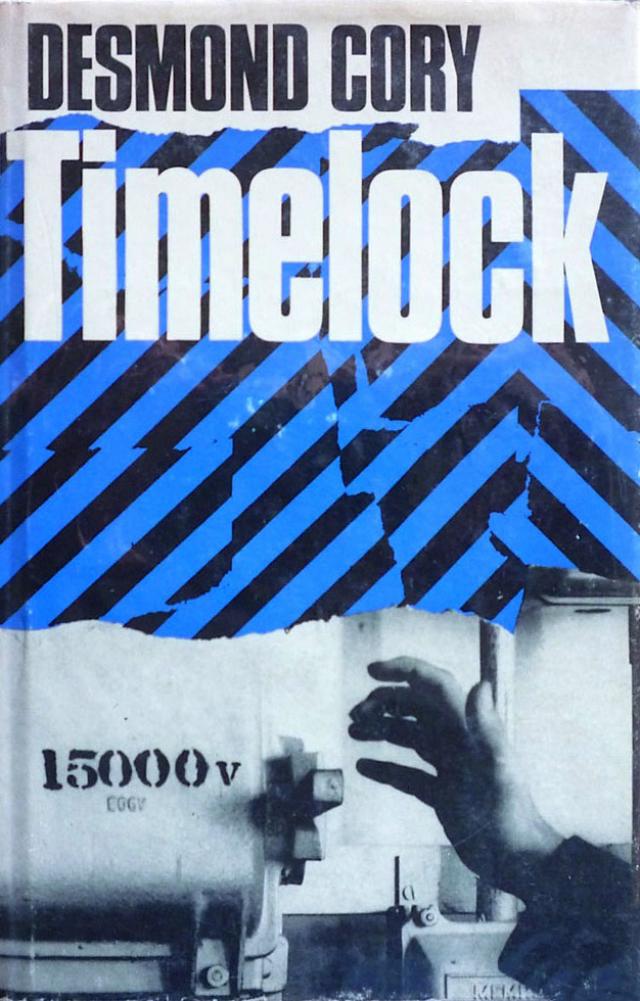
Timelock, p.1
Timelock, page 1
part #15 of Johnny Fedora Series


Gleaming drops of water ran down the girl’s smooth back as Johnny ripped aside the shower curtain.
“What do you mean, we’re married?” he demanded.
The girl stopped soaping herself. “Don’t you remember?” She sounded incredulous. “Eight days ago, at the consulate.” She shut the water off and stepped out of the tub.
Johnny stared. No, he wouldn’t have forgotten her. But marriage? Ridiculous; he wouldn’t—he couldn’t—take on the responsibility of a wife.
The girl stood very close to him now. Her hands began to unbutton his shirt. “The bed,” she whispered, “behind you.” She laughed softly, her lips touching his ear. “After all, we’re married . . .”
A TIME BOMB SLOWLY TICKING AWAY. . .
THERE WERE FIVE MORE HOURS TO GO—Johnny Fedora watched the needle stab his arm. Truth serum. Johnny felt calm, detached. He couldn’t betray what he didn’t know-could he?
FOUR HOURS TO GO—The phone gave a shrill ring. The Spanish official who ranked very near Franco spoke in his customary level tones. He was giving final instructions for his high-treason plan.
THREE HOURS—The girl was strapped to the complex electrical torture machine. She was totally nude. One flick of the switch and the white skin would turn coal black, the smell of burning flesh would fill the room.
TWO—All was quiet at Secret Service Headquarters in London. British Intelligence seemed strangely unaware of the imminent explosion that could blow the free world right off the map.
THERE WAS ONE HOUR LEFT—Terror made Johnny’s skin crawl. Three vital weeks were missing from his life— he’d suffered total amnesia just before the enemy’s horror plan began. But things kept hammering inside Johnny’s head. What was “Cell 11”? Who was the sensuous beauty who kept insisting she was now his wife? Why did she lie about her bizarre past—then make sure he found out the truth?
Johnny had to have answers.
AND THERE WAS ONE HOUR LEFT!
“Intricate intrigue, vigorous
action, and a more provocative
girl than James Bond ever met”
—The New York Times
TIMELOCK
Desmond Cory
Originally published by Walker and Company,
a division of Publications Development Corporation.
Copyright © 1967 by Desmond Cory
All rights reserved
Library of Congress Catalog Number: 67-23099
First printing 1968
AWARD BOOKS are published by
Universal Publishing and Distributing Corporation
235 East Forty-fifth Street, New York, N. Y. 10017
TANDEM BOOKS are published by
Universal-Tandem Publishing Company Ltd.
33 Beauchamp Place, London SW 3, England
Manufactured in the United States of America
1
ACUÑA, too, was driving to Barcelona. And he, too, was unconscious; or more precisely, asleep. His chauffeur had taken the no. 2 highway from Madrid and was, at the time of Fedora’s sad collapse, nearing Zaragoza; he had just negotiated the rather awkward stretch that leads into La Almunia and was now, once more on the open plains, making up for lost time. From here on, he hoped to average a steady sixty kilometres or so an hour; he knew, in any case, that he’d better. Acuña was comfortably asleep m the back of the car, but at 5 a.m. on the dot he’d be waking up, and when he did he’d find himself in Barcelona. Or else. . . .
Acuña was a very important man. He was, among other things, chief security advisor to Munoz Grandes, who was Deputy Head of State to General Franco. That was his official post. He had a number of less official posts that the chauffeur knew about, posts guaranteeing him a yearly income of some five hundred thousand pesetas, but these posts somehow didn’t get talked about much—certainly not by the chauffeur, who knew the value of discretion. As for his private life, that didn’t get talked about at all. It centred mostly on a flat off Recoletos where not one but two young ladies were together enabled to lead (as the chauffeur was convinced) the life of Riley, this in return for their doubtless highly skilled services from two to five p.m. daily. Daily. Acuña was short and very, very fat and hideously ugly; he had to be, moreover, pushing sixty. Hence the chauffeur’s discretion, it may be said, was tinged with a certain admiration. And when all was said and done, it . gave him something to think about on these long and boring night journeys. Food, so to speak, for the imagination. Acuña usually slept. No wonder.
. . . But always woke at five. On the dot. The chauffeur glanced briefly at the clock on the dashboard and compressed his lips; the road, as they travelled eastwards, was getting greasier. But so far, they were making good time.
By 4.45, they were through San Feliu and the lights of Barcelona were a hazy glow in the sky to the north-east. Twelve minutes later Acuña, on the back seat, stirred and then opened his eyes; he was awake. No yawning. No stretching. Hardly a movement. He was awake; that was all. The black car fled down the wide streets, the pavements to either side brushed orange by the overhead lights, shining wetly in the reflected beam of the headlamps. The air was damp. It made quite a change from Madrid.
“Where are we?” Acuña asked.
He didn’t mean, Barcelona. He knew that already. He wanted to know exactly. “Going down Regencia, sir, towards the port. We’ll be at the Torre in about four minutes.”
Acuña grunted. After a while, he raised a hand to massage his unshaven chin. The tyres hissed on the road; the tall buildings drifted by. They passed a bicyclist, then two more; then a solitary taxi, going the other way. The car turned sharp left, ignoring the red admonition of a traffic light; Acuña took out and lit a short thin cigar. In the Plaza de la Torre, the car came to a halt.
The chauffeur opened the door. Acuña got out.
“I’ll phone you if I need you asrain today.”
“Yessir.”
No case, no coat, no hat. Acuña waddled towards the front door of the house that stood at the comer, not acknowledging the chauffeur’s farewell salute. The door opened while he was still some ten paces distant from the front steps; a dark-suited figure showed briefly inside* silhouetted against the light that burned in the narrow hallway. Acuña didn’t nod to him, either. He walked unhesitantly in, and the door closed behind him. The chauffeur spat on to the pavement, clambered back into the Dodge and let in the clutch; the garage attendants at the Avenida would be on duty and waiting for him and so, with any luck, would be a cup of hot coffee. It hadn’t been too bad a trip. Routine.
“Anything from Recoletos?” Acuña asked.
“No, sir.” The man in the dark suit was trotting along at his heels like a well-trained gun dog. “Nothing.''
“Put me through.”
“En seguida, señor”
Acuña went through into the Divisional Coordinator’s office. A desk piled high with papers; a telephone. He sat down. The man in the dark suit picked up the telephone and commenced to dial. At Recoletos, they’d be waiting, too.
The fiat in Recoletos wasn’t exactly what the chauffeur thought it was. It was the communications centre of the Spanish Secret Police; a very efficient organisation, in many ways. Acuña thought so, anyway, and he was in a good enough position to judge. He was the head of it.
“Where’s the Coordinator?”
“On operations, sir. He expects to be back before ten o’clock. You’ll find his memoranda, sir, on the desk.”
“Ugh,” Acuña said.
There was no shortage of papers on the desk. There was a whole mountain of them. Acuña started to go through them. The Madrid call came through, almost at once, and he gave brief instructions without lifting his eyes from the folder open on the desk in front of him. When he had finished reading the folder, he laid it to one side and took another. Time went by. At irregular intervals, the man in the dark suit came in from the next-door office, earning new folders, messages, telegram slips and on one occasion an Interpol Blue. Acuña took no notice. At ten o’clock, he was still sitting there; the pile of papers had shrunk to perhaps a quarter of its former bulk. He went on reading, reading, reading. Nothing disturbed his concentration. This, after all, was his job; he was used to it. Papers, papers, papers.
Routine.
. . . . Only this time it wasn’t, quite.
Acuña was the head of the Secret Police, and had been for years. He was an expert at counter-espionage; he had to be. The Russians had a very high opinion of him; or very low, according to how you looked at it. They didn’t like him at all. Nor did Franco. But his record was impressive. In his own mind, though, he was really little more than a jigsaw man. Jumbled pieces came to him; he tried to fit them together. Sometimes he could and more often he couldn’t. In the former case, action would be taken; sometimes in accordance with his recommendations and sometimes not. In the latter case, nothing happened at all. He just went on trying. Acuña hardly ever made a move until he was sure. Completely' sure. They said he was cunning, but really he was only cautious.
He liked, when he could, to work with younger men. Less experienced, more impulsive. They provided the thrust, packed the cylinder with petrol vapour. Acuña was the brake. He braked at the right moments and he did the steering. What matters in the long run is to get there. The way you brake, the way you steer, you maybe use up a lot of petrol. That didn’t matter. There would always be young men with brains and courage and energy, and Acuña knew how to find them. That was the least of his problems.
At one minute past ten, the latest discovery came in. The Coordinator of the Catalonia Division: Paco Rivas. Thirty-three years old; tall for a sevillano, six foot one, and with plenty of bulk to set off the height. Bulk, not fat. Just over fourteen stone, with a deflated chest measurement of thirty-eight inches. Dark wavy hair and a creased, sun-tanned, intelligent, extremely active face. Far too active to be ever called studious, though he’d studied at Madrid and at the Sorbonne and had a Ph.D. Vienna in clinical psychiatry. The face guaranteed the energy and the body the stamina; Rivas, Acuña hoped, would last a good deal longer than some of the others. Three or four years, with any luck. Though it depended a good deal, of course, on who Rivas had to tangle with; you could have called him unlucky, in that respect. That was why the present jigsaw wasn’t a routine problem. Not exactly.
Acuña blinked at him with his flat and red-rimmed eyes. “Well, now,” he said.
“It’s not too good, jefe. Not too good.”
“Let’s have the picture. As you see it.”
“It’s still not perfectly clear.” Rivas hadn’t been told he could sit down, so he remained standing. “Things have been going on at Villafranca. We don’t know what. There’s been a fire there, and at least two bodies have been recovered. We don’t know whose. Ortiz is almost certainly dead. He was in that aeroplane accident and we’re waiting the assessor’s report. Since it crashed in the sea, it may be a long time in coming. We’re assuming sabotage. Ortiz’s wife is now in France. We missed her at the frontier, probably by about twenty minutes. The Englishman has to be still in this country; at any rate, we’ve no report as to his having left. We’re hoping to regain touch with him this morning. And there’s one thing at least we’re quite sure of. It’s Fedora.”
“Yes,” Acuña said. “It’s Fedora.” A faint shadow of expression crossed his face, but not of any recognisable emotion. It was just a brief departure from total impassivity; that was all. “. . . Sit down,” Acuña said.
Rivas did so, promptly, crossing his knees with a movement so abrupt as to be almost a jerk. “And that has to mean Feramontov. At the ether end.”
“Ortiz, dead. Madame Ortiz, in France. Fedora, out of contact. And Feramontov never in it. Yes. Go on.”
“It’s not good. I know it’s not good.”
“Go on.” Acuña said.
“We’ve reason to suppose that Feramontov was picked up by Ortiz's yacht. Well, the yacht got to Alicante last night. I’ve sent an agent there to question the skipper and to pick up any other loose threads. There’s not much—”
“Who did you send? Alonso?”
“No. My brother.”
“Maybe,” Acuña said, “you should have gone yourself.”
“There seemed to be so much to be cleared up right here.”
He didn’t say it as though he felt uncertain, but his eves turned away from Acuña and towards the window. The square outside was still deserted; it wasn’t raining, but there was rain in the offing. Not a bright morning, by any means.
“. . . To sum the whole thing up,” Rivas said. “I thought there was a chance—no more than that—that Feramontov might try to contact Ortiz. So I put someone in at Villafranca, just to keep tabs. At the worst you could say that I should have put in someone more experienced . . . but it was an off-chance, anyway, and Alonso fitted pretty well into that set-up. As it turned out, there wasn’t much wrong with the reports that came in. I hadn’t allowed for Fedora showing up, of course. Just possibly a more experienced operative would have got on to him sooner, but I can’t really blame Alonso for that— the fault was mine, if anyone’s. I saw Ortiz as the objective, really, with Feramontov as a barely possible ultimate target. What happened was that the people in Madrid didn’t take the reports very seriously, because they didn't see how Feramontov could be anywhere near Barcelona. But it was Feramontov. So they were wrong.”
“I wouldn’t say wrong,” Acuña said. And Rivas’ eyes came back to him. . . Who else could it have been?”
“Oh, it was Feramontov all right. In and out again— the typical technique. All I meant was that the Madrid boys had their reasons. They thought we had him holed up down in the south, they thought he couldn’t make a break without being nabbed. Our cordons don’t slip—you know that. They weren’t wrong in making that assumption.”
“But then how did he do it?”
Acuña said nothing, and so Rivas confronted the problem. You could see him doing it. It took him just eight seconds. Then, unexpectedly, he made a circle of left thumb and forefinger, thrust his right forefinger through it. “. . . You don’t mean a leakage?”
“Of course.”
“But that’s not possible.”
“There’s no other explanation. And if there is, it goes to confirm what I’ve been suspecting these past six months. One moment he’s bottled up, the next he isn’t. So there’s a leak. There has to be.”
He had been sitting on a hard chair for just over five hours. Now he shifted position a little, easing gently forwards his huge posteriors; the first indication he’d yet given of any kind of physical discomfort. “That’s bad,” Rivas said. “That’s ready bad.”
By way of reply, Acuña snorted.
“High level, I suppose?”
“I’d say the highest. Ministerial, maybe. I don’t know yet. But,” Acuña said, “I will.”
Rivas pushed out his lower lip, pondering deeply. Leak, he thought; a four-letter word. In the Secret Police and in similar organisations, the only one that really matters, Top Priority Taboo. You’re supposed to grow pale at the sound of it; he wasn’t sure he hadn’t. Because the Secret Police had enemies, hundreds of enemies, and dangerous ones, and in that one word Secret lay their sole protection. To set the one word against the other is like setting a ferret on to a rabbit. It was bad, really bad.
“I don’t see how we’ll ever catch Feramontov,” he said, “if he knows just what we’re planning to do as soon as we know it ourselves.”
“I don’t say as soon as” Acuña said comfortably. “No, I imagine that there’s some delay. As much as twelve hours, perhaps. It can’t be that easy.”
“But even so.”
“Quite,” Acuña said. “Even so. Of course, there’s another way of looking at it.” He took out another of his cigars, bit the end off it, spat inelegantly into the wastepaper basket. “We find the leak, we find Feramontov. We leak the wrong information through to him, and he’s in the bag. Had you thought of that?”
“I can’t say I had,” Rivas said. “Leaks. I hate leaks.”
“We’ve had them before. No doubt we’ll have them again. And they can be useful. It’s a matter of thinking of the best way of . . .” The match sputtered in Acuña’s fingers; he blew out a symbolical wreath of smoke. As he did so, the telephone rang.
Rivas reached for it, listened in silence for a moment. “Yes,” he said. “Put the call through.” And looked up. “Here’s Alonso on the line. Now we may learn a little more about something or other.”
The hotel was not expensive though it overlooked the beach, the sloping beach of Alicante with its fringe of palm trees. The name of the hotel was the Albuferete. That morning, as in Barcelona, the rain had held off; but the levante was blowing, bringing with it grains of dust and of fine, stinging sand, so that most of the hotel windows over-looking the beach were closed and shuttered. Not all of them, however. There was an open window on the first floor; and through this a cool draught entered, lifting now and again the calico curtains, raising a tuft of hair from the forehead of the man who lay on the floor beneath them, leaving on his upturned face the filmiest imaginable deposit of white dust.
The other man in the room stood a little to the left and clear of the open window, staring down at the corpse. A tall, well-built young man who looked very much like Rivas and was, in fact, Rivas’ younger brother; there were five brothers altogether, but only two of them were policemen. This young man looked like Rivas, yes; but principally he looked unhappy. He was worried, not so much about the corpse as at what the corpse implied. It implied that there might quite soon be four Rivas brothers, and only one of them a policeman. Which didn’t make for a cheerful frame of mind.






