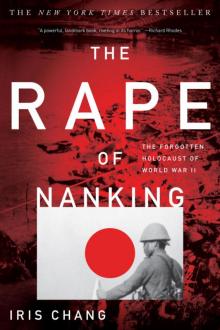
The rape of nanking, p.23
The Rape of Nanking, page 23


Perhaps it was General Matsui Iwane who summed up the prevailing mentality of self-delusion best when he attempted to justify Japanese oppression of China. Before he left for Shanghai in 1937, he told his supporters: “I am going to the front not to fight an enemy but in the state of mind of one who sets out to pacify his brother.” Later he would say of the invasion of China:
The struggle between Japan and China was always a fight between brothers within the “Asian Family.”… It had been my belief during all these days that we must regard this struggle as a method of making the Chinese undergo self reflection. We do not do this because we hate them, but on the contrary we love them too much. It is just the same as in a family when an elder brother has taken all that he can stand from his ill-behaved younger brother and has to chastise him in order to make him behave properly.
Whatever the course of postwar history, the Rape of Nanking will stand as a blemish upon the honor of human beings. But what makes the blemish particularly repugnant is that history has never written a proper end for the story. Even in 1997, the Japanese as a nation are still trying to bury the victims of Nanking—not under the soil, as in 1937, but into historical oblivion. In a disgraceful compounding of the offense, the story of the Nanking massacre is barely known in the West because so few people have tried to document and narrate it systematically to the public.
This book started out as an attempt to rescue those victims from more degradation by Japanese revisionists and to provide my own epitaph for the hundreds upon thousands of unmarked graves in Nanking. It ended as a personal exploration into the shadow side of human nature. There are several important lessons to be learned from Nanking, and one is that civilization itself is tissue-thin. There are those who believe that the Japanese are uniquely sinister—a dangerous race of people who will never change. But after reading several file cabinets’ worth of documents on Japanese war crimes as well as accounts of ancient atrocities from the pantheon of world history, I would have to conclude that Japan’s behavior during World War II was less a product of dangerous people than of a dangerous government, in a vulnerable culture, in dangerous times, able to sell dangerous rationalizations to those whose human instincts told them otherwise. The Rape of Nanking should be perceived as a cautionary tale—an illustration of how easily human beings can be encouraged to allow their teenagers to be molded into efficient killing machines able to suppress their better natures.
Another lesson to be gleaned from Nanking is the role of power in genocide. Those who have studied the patterns of large-scale killings throughout history have noted that the sheer concentration of power in government is lethal—that only a sense of absolute unchecked power can make atrocities like the Rape of Nanking possible. In the 1990s R. J. Rummel, perhaps the world’s greatest authority on democide (a term he coined to include both genocide and government mass murder), completed a systematic and quantitative study of atrocities in both the twentieth century and ancient times, an impressive body of research that he summed up with a play on the famous Lord Acton line: “Power kills, and absolute power kills absolutely.” The less restraint on power within a government, Rummel found, the more likely that government will act on the whims or psychologically generated darker impulses of its leaders to wage war on foreign governments. Japan was no exception, and atrocities such as the Rape of Nanking can be seen as a predictable if not inevitable outgrowth of ceding to an authoritarian regime, dominated by a military and imperial elite, the unchallenged power to commit an entire people to realizing the sick goals of the few with the unbridled power to set them.
And there is yet a third lesson to be learned, one that is perhaps the most distressing of all. It lies in the frightening ease with which the mind can accept genocide, turning us all into passive spectators to the unthinkable. The Rape of Nanking was front-page news across the world, and yet most of the world stood by and did nothing while an entire city was butchered. The international response to the Nanking atrocities was eerily akin to the more recent response to the atrocities in Bosnia-Herzegovina and Rwanda: while thousands have died almost unbelievably cruel deaths, the entire world has watched CNN and wrung its hands. One could argue that the United States and other countries failed to intervene earlier to prevent the Nazis from carrying out their “final solution” because the genocide was carried out in wartime secrecy and with such cold efficiency that until Allied soldiers liberated the camps and saw with their own eyes the extent of the horror, most people could not accept the reports they had been getting as literally true. But for the Rape of Nanking, or for the murders in the former Yugoslavia, there can be no such excuse. The Nanking atrocities were splashed prominently across the pages of newspapers like the New York Times, while the Bosnia outrages were played out daily on television in virtually every living room. Apparently some quirk in human nature allows even the most unspeakable acts of evil to become banal within minutes, provided only that they occur far enough away to pose no personal threat.
Sad to say, the world is still acting as a passive spectator to the second Japanese rape—the refusal of the Japanese to apologize for or even acknowledge their crimes at Nanking, and the attempts by Japanese extremists to erase the event from world history. To get a better handle on the magnitude of the injustice, one only has to compare the postwar restitution that the governments of Japan and Germany have made to their wartime victims. While it is certainly true that money alone cannot give back to murder victims their lost lives or erase from memory the tortures the survivors endured, it can at least convey that what was done to the victims represented the evil of others.
As of 1997 the German government has paid at least DM 88 billion in compensation and reparations and will pay another DM 20 billion by the year 2005. If one factors in all the money the Germans have paid in compensation to individual victims, restitution for lost property, compensatory pensions, payments based on state regulations, final restitution in special cases, and money for global agreements with Israel and sixteen other nations for war damages, the total comes to almost DM 124 billion, or almost $60 billion. The Japanese have paid close to nothing for their wartime crimes. In an era when even the Swiss have pledged billions of dollars to create a fund to replace what was stolen from Jewish bank accounts, many leading officials in Japan continue to believe (or pretend to believe) that their country did nothing that requires compensation, or even apologies, and contend that many of the worst misdeeds their government has been accused of perpetrating never happened and that evidence that they did happen was fabricated by the Chinese and other Japan bashers.
The Japanese government has taken the position that all wartime reparation issues were resolved by the 1952 San Francisco Peace Treaty. A close reading of the treaty, however, reveals that the issue was merely postponed until Japan was in a better financial situation. “It is recognized that Japan should pay reparations to the Allied Powers,” the treaty states in chapter 5, article 14. “Nevertheless it is also recognized that the resources of Japan are not presently sufficient, if it is to maintain a viable economy, to make complete reparations for all such damage and suffering and at the same time meet its other obligations.”
One of the greatest ironies of the cold war is that Japan not only eluded its responsibility to pay reparations but received billions of dollars in aid from the United States, which helped build its former enemy into an economic powerhouse and competitor. Now there is considerable concern in Asia about the prospect of renewed militarism among the Japanese people. During the Reagan administration the United States pushed Japan to beef up its military power—something that alarmed many who had suffered years of Japanese wartime agression. “Those who ignore history tend to become its victims,” warned Carlos Romulo, the Philippine foreign minister and Pulitzer Prize winner who served as General Douglas MacArthur’s aide-de-camp during World War II and understood the competitive national spirit engendered by the Japanese culture. “The Japanese are a very determined people; they have brains. At the end of World War II, no one thought that Japan would become the foremost economic power in the world—but they are. If you give them the chance to become a military power—they will become a military power.”
But the cold war has ended, China is fast emerging from the chrysalis of communism, and other Asian nations that were bullied by Japan during the war may challenge it as they grow ascendant in the international economic arena. The next few years may well witness giant strides in activism regarding Japanese wartime crimes. The American public is growing demographically more Asian. And unlike their parents, whose careers were heavily concentrated in scientific fields, the younger generations of Chinese Americans and Chinese Canadians are fast gaining influence in law, politics, and journalism—professions historically underrepresented by Asians in North America.
Public awareness of the Nanking massacre increased substantially between the time I first started to research this book and the time I finished it. The 1990s saw a proliferation of novels, historical books, and newspaper articles about the Rape of Nanking, the comfort women, Japanese medical experimentation on wartime victims, and other Japanese World War II atrocities. As of 1997 the San Francisco school district plans to include the history of the Rape of Nanking in its curriculum, and blueprints have even been drawn up among Chinese real estate developers to build a Chinese holocaust museum.
As this book neared completion, the U.S. government was starting to respond to activist demands to pressure the Japanese to confront their wartime past. On December 3, 1996, the Department of Justice established a watch list of Japanese war criminals in order to bar them from entering the country. In April 1997, former U.S. Ambassador Walter Mondale told the press that Japan needs to face history honestly and directly and expressed his wish that Japan make a full apology for its war crimes. The Rape of Nanking even made its way into a bill that will soon be introduced into the U.S. House of Representatives. Through the spring of 1997, legislators worked with human rights activists to draft a bill that will condemn Japan for the maltreatment of U.S. and other prisoners during World War II and demand an official apology and compensation for its wartime victims.
The movement to force the Japanese government to face the full truth about the legacy of its wartime government is gaining support even in Japan, where official denials of wartime atrocities have aroused considerable shame and embarrassment among those citizens who see themselves as more than simply and solely Japanese. A vocal minority is convinced that their government must acknowledge its past if it expects to command trust from its neighbors in the future. In 1997 the Japanese Fellowship of Reconciliation released the following statement:
In the past war, Japan was arrogant and pompous, behaved as aggressors in other Asian countries and brought misery to a great number of people, especially in China. For fifteen years around the 1930s, Japan continued to make war against the Chinese. War actions continued and victimized tens of millions of people. Here, we sincerely would like to apologize for Japan’s past mistakes and beg your forgiveness.
The present generation in Japan faces a critical choice. They can continue to delude themselves that the war of Japanese aggression was a holy and just war that Japan happened to lose solely because of American economic power, or they can make a clean break from their nation’s legacy of horror by acknowledging the truth: that the world is a better place because Japan lost the war and was not able to impose its harsh “love” on more people than it did. If modern Japanese do nothing to protect the truth, they run the risk that history will leave them as tarnished as their wartime ancestors.
Japan carries not only the legal burden but the moral obligation to acknowledge the evil it perpetrated at Nanking. At a minimum, the Japanese government needs to issue an official apology to the victims, pay reparations to the people whose lives were destroyed in the rampage, and, most important, educate future generations of Japanese citizens about the true facts of the massacre. These long-overdue steps are crucial for Japan if it expects to deserve respect from the international community—and to achieve closure on a dark chapter that stained its history.
EPILOGUE FOR THE 2011 EDITION
by Brett Douglas,
September 23, 2011
WHEN I FIRST MET my wife, Iris Chang, in October of 1988, she was a beautiful, brilliant, charming girl who was full of life. I wouldn’t have been surprised if someone had told me she would someday write a best-selling book that would be translated into 15 languages. What does surprise me is that I am now writing an epilogue to The Rape of Nanking seven years after her death. With the energy, passion, and drive that Iris showed at age thirty, I thought it was likely she would be writing great books well in her eighties and nineties.
When we met, neither of us had dated more than a few times, but we soon both knew we were a perfect match. We were blessed to have sixteen very happy years together. At the time of this writing, two books have been published about Iris’s life: Finding Iris Chang by Paula Kamen and The Woman Who Could Not Forget by her mother, Ying-Ying Chang. These are both good works, and I encourage those who want to learn more about Iris to read them. Iris’s life ended far too soon, and because she was a private person, much of her life and death has been shrouded in some mystery. I’m grateful to Basic Books for giving me the opportunity to fill in some of the holes and to remove some of the mystery associated with Iris’s life so her legacy and the legacy of her book can endure.
Ying-Ying Chang’s The Woman Who Could Not Forget provides a detailed description of Iris’s entire life, and I have no desire to try to improve upon that work. Instead, I’ll focus on a few key factors I believe led to her success. Both of her parents were Harvard PhDs who spent their careers doing scientific research. Thus, Iris learned to value intellectual achievement at a very early age. She spent thousands of hours as a youth at the University of Illinois library and other local libraries learning to read and process information quickly. Iris compiled an exhaustive list of all Nobel Prize–and Pulitzer Prize–winning books and Academy Award–winning films, and she proceeded to read and watch each and every one. Her days off consisted of methodically working her way through these books and films.
Iris attended the University of Illinois’s University High School, a tiny academic pressure cooker populated primarily by academically driven professors’ children who had all passed a rigorous entrance exam. The high school has produced several Nobel Prize winners and many other graduates who went on to achieve extraordinary success. In 1985, Iris was one of the few women who entered the University of Illinois Urbana-Champaign’s competitive Math and Computer Science program. She was on track to graduate in just over three years, but she changed her major to journalism when she was a few hours short of a degree. At the time, it was relatively rare for a girl to study Math and Computer Science, it was rare for someone to complete the program that quickly, and it was extremely rare for someone who had completed the program so easily to change majors at the very end.
Most would expect someone who changed majors after almost three years to be significantly behind her peers, but Iris soon made up the difference and won internships at Newsweek, the Associated Press, and the Chicago Tribune. While at the Tribune , she discovered her real passion was writing lengthy feature stories, so she applied and was admitted to the prestigious Writing Seminars program at Johns Hopkins University. While she was there, at the age of only twenty-two, she met her editor and later her agent, Susan Rabiner. Susan gave her a topic, and Iris started research on her first book, The Thread of the Silkworm.
When Iris completed her degree from Johns Hopkins, she moved to Santa Barbara, California, to live with me. Iris was always interested in film, so she took a portfolio of photos to a talent agency and was soon selected to be a dancer in an MC Hammer video. However, Iris had a MacArthur Foundation grant proposal due the very next day, so she declined their offer. We thought it was probably the first time anyone had ever turned down MC Hammer and his production company for that reason. Iris made the right decision. She won the MacArthur Foundation grant.
Iris later went on to win a National Science Foundation grant to continue her research on The Thread of the Silkworm. What was truly amazing was that Iris never completed a science degree, and she had no formal affiliation with any university or research institution.
Along with her beauty, her intelligence, and her education, two other factors contributed greatly to Iris’s success. She was never shy about asking someone, no matter how famous, for help or advice, and she was always trying to improve herself. For instance, in 1991 Iris was very nervous about the prospect of giving a short toast in front of two hundred people at our wedding reception. Yet she consciously worked at public speaking so that by the time The Rape of Nanking was published in 1997, she could hold the attention of a thousand people for an hour or longer while she talked about her research and her books.
During the first ten years of our relationship, it was a true pleasure to watch Iris build herself from a sometimes shy and introverted person into “Super Iris,” the famous author and historian who could write best-selling books, keep audiences enthralled with her speeches, and win debates on national television. It was much sadder to see “Super Iris” rapidly succumb to mental illness during the summer of 2004.
There remain a number of myths and misunderstandings about the life and career of Iris Chang. Even I still have a few questions of my own. I can, however, offer information that I think will offer clarity to readers of this book. The first misunderstanding has to do with whether there was a “Eureka! Moment.” Iris attended a conference in Cupertino, California, late in 1994 where she saw photos from the Rape of Nanking. There is a common myth that Iris saw the photos and decided then and there that she had to write a book on the atrocity. This is a nice story, but it is entirely contrary to the way Iris did her work. Iris maintained a meticulous file of book ideas, which grew to 400 potential projects by 2004. Iris had heard stories about the Rape of Nanking as a child from her parents and grandparents. She told me shortly after we started dating in October 1988 of her desire to write a book about the Nanking massacre. As soon as she completed the final draft of her first book The Thread of the Silkworm, she determined that Japan’s assault on Nanking was the most promising topic for her second book, and so she started research. A month later, in the fall of 1994, she attended the conference in Cupertino where she met with the group of activists who sponsored it. She saw many photographs of victims, and she became acquainted with many people who were to become extremely helpful to her in her research. Yet, somehow the idea got started that looking at the photographs at the conference gave her the inspiration to write the book, and that myth has continued to grow. Iris never made an impulsive career decision like that. Writing The Rape of Nanking was something she had planned for years, and she was researching the book already when she attended the conference.